
Here’s a number that should get the attention of every manufacturer in Wisconsin: $253 million. That’s how much the average large manufacturing plant loses every year to unplanned downtime alone…and the per-hour cost of that downtime has roughly doubled since 2019.
Now here’s the good news: the tools to cut that number dramatically already exist, they’re affordable, and they don’t require a PhD to use.
This is Keith Klein, founder and CEO of OnYourMark.com LLC. We’ve been working with Wisconsin manufacturers since the late 1980s: first in industrial marketing, then in web design and internet marketing, and now in web work coupled with AI-powered business solutions, particularly AI in manufacturing and other industries. What I’m seeing right now on shop floors across this state is a genuine turning point. AI in manufacturing isn’t coming. It’s here. And the gap between manufacturers who’ve figured that out and those who haven’t is widening every quarter.
Let me walk you through five ways Wisconsin manufacturers are using AI — with real numbers — and five more applications that most shop owners haven’t considered yet but probably should.
Wisconsin Manufacturers are Using AI:
THE FIVE THEY’RE USING NOW
1. Predictive Maintenance: Fixing Machines Before They Break
This is the single biggest ROI story in AI in manufacturing today. Traditional maintenance falls into two buckets: you either fix things on a schedule, whether they need it or not (preventive), or you wait until something breaks and scramble (reactive). Predictive maintenance manufacturing changes that equation entirely.
AI-powered sensors monitor vibration, temperature, acoustics, and power draw in real time. Machine learning models analyze those patterns and flag anomalies weeks or months before a failure occurs. The result, according to Deloitte: maintenance costs drop 25%, uptime increases 10–20%, and downtime incidents fall by half. McKinsey puts the maintenance cost reduction even higher, at up to 40%.
For Wisconsin manufacturers running CNC machines, stamping presses, or injection molding equipment, predictive maintenance manufacturing is the clearest path from “we should try AI” to “AI is saving us real money.” Industry data from IIoT World Days 2025 shows that computer vision and predictive maintenance consistently deliver ROI within three to six months — not years.
The technology is also now accessible to small and mid-size shops. IoT sensor prices have dropped to as low as $0.10–$0.80 per unit, and platforms like Infinite Uptime and Litmus can connect to legacy PLCs from machines built in the 1960s through the 1980s. You don’t need a new factory. You need a few sensors and the right software.
2. AI Quality Inspection: Catching What Human Eyes Miss
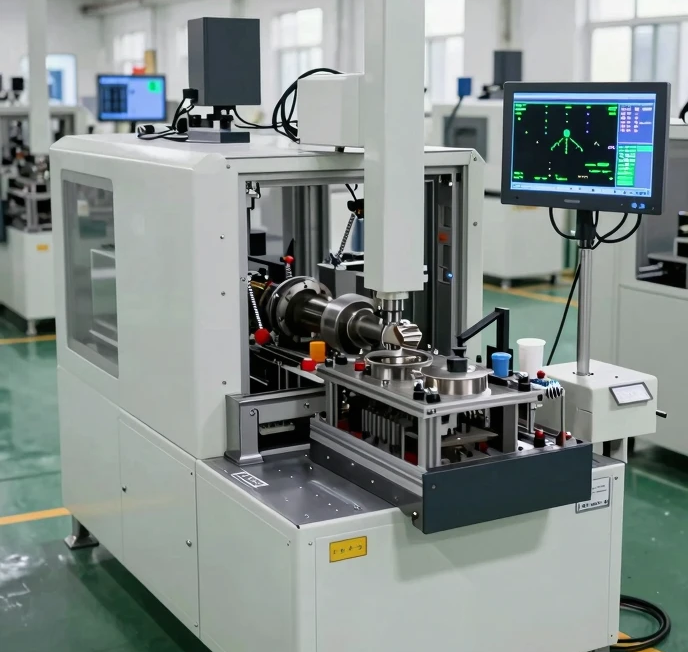
Manual visual inspection has an accuracy rate of roughly 80%. That means one in five defects gets through. For a manufacturer shipping precision parts, that 20% miss rate is a liability — in warranty claims, rework, scrap, and customer trust.
AI quality inspection manufacturing is changing this dramatically. Computer vision systems using deep learning now achieve 99%+ accuracy in defect detection, outperforming expert human inspectors by 37% in controlled studies. A leading European automotive manufacturer implemented AI quality inspection manufacturing in 2024 and saw warranty claims related to assembly defects drop 47% within the year.
Intel saves $2 million annually using AI vision inspection on wafer production. Their system catches micron-level defects — scratches, cracks, bubbles, grinding marks — that human inspectors physically cannot see at production speed.
According to McKinsey’s 2024 Manufacturing Technology Trends report, 76% of surveyed manufacturers are either implementing or planning to implement AI visual inspection within the next 18 months. The AI industrial defect detection market is projected to grow from $2.66 billion in 2025 to over $6 billion by 2035.
For Wisconsin manufacturers in metal fabrication, this is especially relevant. Surface defects on metallic parts — scratches, blowholes, cracks, and grinding irregularities…are exactly the defect categories where AI vision systems excel. Modern systems can detect defects in under 200 milliseconds per part, meaning real-time inspection at production speed.
3. RFQ Response and Quoting Automation
Every manufacturer knows the pain of RFQs. A request comes in, someone has to read the specs, pull up material costs, estimate labor, check machine availability, calculate margins, and get a quote back — ideally before the prospect moves on to a competitor.
AI tools like Claude, ChatGPT, and Gemini can now parse RFQ documents (even PDFs with drawings), extract specifications, cross-reference them against your capabilities and pricing databases, and generate draft quotes in minutes rather than hours or days. The AI doesn’t replace the estimator’s judgment — but it does the heavy lifting of data extraction and calculation, freeing your team to focus on the decisions that actually require experience.
For Wisconsin manufacturers, AI adoption in the quoting process means faster response times, more consistent pricing, and fewer errors in the math. In a market where a same-day quote can win business over a three-day quote, speed is a competitive advantage that AI delivers immediately.
4. ISO Documentation and Compliance Management
If you’re ISO 9001 certified — or considering it — you already know the documentation burden. Procedures, work instructions, corrective actions, internal audits, and management reviews. The paperwork can bury a small quality team.
AI excels at generating, organizing, and maintaining this kind of structured documentation. Feed it your existing procedures, and it can draft updated versions when processes change. Give it a nonconformance report, and it can suggest root cause categories and corrective actions based on your history. Ask it to prepare an internal audit checklist, and it will produce one aligned with your specific scope.
This isn’t theoretical. Manufacturers across the country are using AI in manufacturing quality systems right now — not to replace their quality managers, but to give those managers a tool that handles the 80% of documentation work that’s repetitive, so they can focus on the 20% that requires judgment and experience. For Wisconsin manufacturers, especially smaller shops where the quality manager wears three other hats, this is a significant time-saver.
5. Supply Chain Monitoring and Risk Assessment
The supply chain disruptions of 2020–2024 taught every manufacturer a painful lesson: you can’t just trust that your suppliers will deliver. AI-powered supply chain tools now scan global news, weather alerts, shipping data, government advisories, and financial reports to detect risks before they hit your dock.
Large language models and predictive analytics generate risk scores across suppliers, carriers, and routes. They simulate scenarios — what happens if a critical supplier fails, if border controls tighten, if a port shuts down — and recommend adjustments to procurement, routing, and buffer capacity.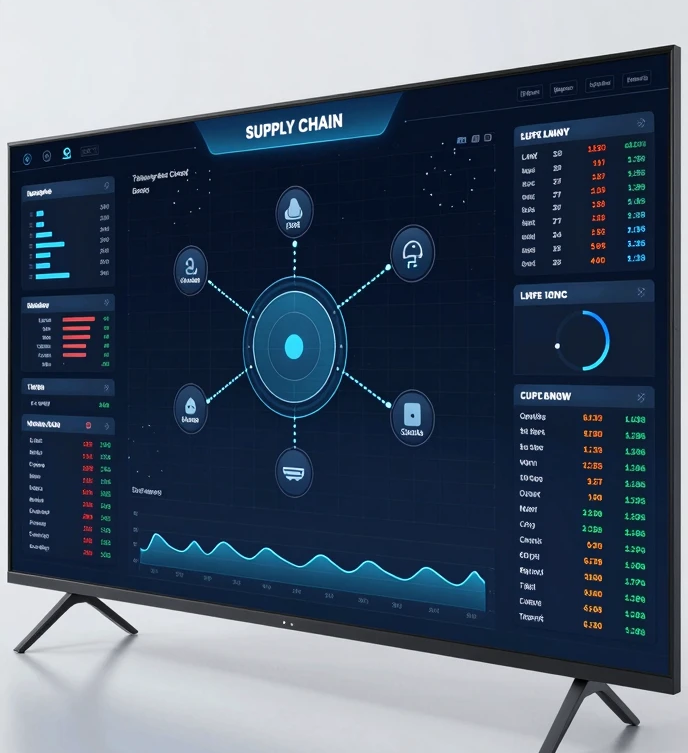
Manufacturers using AI-driven supply chain monitoring have reported a 2.6x ROI within twelve months, according to industry data from 2025. For Wisconsin manufacturers, AI-powered supply chain visibility is especially valuable given the state’s deep integration with Great Lakes shipping, Canadian cross-border trade, and Midwest logistics corridors.
Wisconsin Manufacturers are Using AI:
THE FIVE THEY SHOULD BE USING
The applications above have been proven and are delivering ROI today. The following five are emerging rapidly and represent the next wave of manufacturing automation in 2026 and beyond. Wisconsin manufacturers who get ahead of these now will have a significant competitive edge.
6. Digital Twins for Process Optimization
A digital twin is a virtual replica of your production line, your machines, or even your entire plant. AI models feed it real-time data, allowing you to test changes, such as adjusting throughput rates, adding product lines, and modifying schedules, without touching physical equipment or risking actual production.
Automotive plants using digital twins have achieved 30% reductions in maintenance costs and 40% improvements in equipment uptime. For a Wisconsin metal fabrication shop considering a new cell layout or a capacity expansion, running the scenario through a digital twin first could save tens of thousands of dollars in trial-and-error costs.
7. AI-Powered Workforce Training and Knowledge Capture
Here’s a stat that should concern every manufacturer: 39% of maintenance leaders say knowledge capture and sharing is the most valuable use case for AI in manufacturing. And they’re right. When your most experienced machinist or toolmaker retires, decades of tribal knowledge walk out the door.
AI can capture that knowledge — through structured interviews, documentation of procedures, and creation of searchable knowledge bases — and make it available to every employee on the floor. It can also generate training materials, create step-by-step visual guides, and even power chatbot-style assistants that new hires can query in real time. Manufacturing automation 2026 isn’t just about machines. It’s about preserving and transferring the human expertise that makes your shop run.
8. Energy Management and Sustainability Reporting
AI-driven energy management systems deliver an average of 12% energy savings in manufacturing facilities that deploy them, according to 2025 industry data. The systems identify waste patterns, such as machines idling at full power, HVAC running during off-shifts, compressed air leaks, and recommend or automate corrections.
Beyond cost savings, AI in manufacturing energy management positions your company for the growing wave of sustainability reporting requirements from OEMs and government contracts. If your customers are asking for carbon footprint data or ESG compliance data, AI makes reporting dramatically easier.
9. AI-Assisted Sales and Marketing for Manufacturers
Most Wisconsin manufacturers I work with still rely on word-of-mouth, trade shows, and a decade-old website to generate leads. AI is transforming manufacturing marketing just as dramatically as it’s transforming the shop floor.
AI tools can analyze your ideal customer profile, identify look-alike prospects, generate targeted content, personalize outreach, and even score incoming leads based on likelihood to convert. Paired with a modern CRM, AI-assisted marketing means your sales team spends time on prospects who are ready to buy rather than cold-calling from a purchased list. For Wisconsin manufacturers, AI in sales and marketing is perhaps the most underexplored opportunity — and one of the easiest to implement, because it doesn’t require any changes to your production process.
Contact me at OnYourMark.com for help with AI sales & marketing solutions.
10. Agentic AI: The Autonomous Factory Assistant
This is the frontier. Agentic AI systems don’t just detect a problem and alert you. They autonomously execute multi-step workflows: detect an anomaly, query the ERP for parts availability, schedule a technician, generate a work order — all without a human in the loop at each step.
At IIoT World Days 2025, Milwaukee Tool was highlighted for using AI agents that assist shipping clerks by identifying inventory locations, digitally packing shipments for maximum space efficiency, and auto-generating documentation. That’s a Wisconsin company already operating at this level.
Agentic AI is the next major phase of manufacturing automation, 2026 and beyond. It won’t replace your team — but it will handle the routine coordination work that currently eats up hours of your supervisors’ day. And for any manufacturer already running predictive maintenance and AI quality inspection manufacturing, the step to agentic workflows is a natural progression.
AI in Manufacturing: WHERE TO START
If you’re a Wisconsin manufacturer reading this and thinking, “This all sounds great, but where do I actually begin?” — here’s my advice, and it’s the same advice I give our clients:
Start with one high-impact use case. For most shops, that’s either predictive maintenance for your most critical machine or AI-based quality inspection for your highest-volume line. Run a pilot. Measure the results. Build from there.
Industry data consistently shows that AI in manufacturing delivers ROI within 12 to 24 months for most implementations, with quick wins such as predictive maintenance and computer-vision quality inspection paying back in as little as three to six months.
The manufacturers who’ll thrive in the next decade aren’t necessarily the biggest or the best-capitalized. They’re the ones willing to start, to experiment, and to build manufacturing automation 2026 into their operations one practical step at a time.
If you’d like to discuss how AI can work specifically for your shop, especially in sales and marketing, I’m always happy to have that conversation. Feel free to join other managers and owners for a Wisconsin Business Owners’ Lunch & Learn on Friday, March 27, 2026, in Brookfield. Details at https://www.meetup.com/wisconsin-business-owners/events/313639208/
We welcome your comments, questions, and suggestions. Please contact us with questions. We do invite you to engage with us on social media (just not for immediate needs). Best to call, email, or visit our site for the best response.
As always, if you like, you will find us on the following social media sites, among many others:
Sources and Citations
- Siemens, “The True Cost of Downtime 2024” — Fortune 500 companies lose approximately $1.4 trillion annually (11% of revenues) due to unplanned outages; the average large manufacturing plant loses $253 million per year; the per-hour cost roughly doubled from 2019 to 2024. Cited via MaintainX and iFactory.
- Deloitte — Predictive maintenance can reduce maintenance costs up to 25% and increase uptime by 10% to 20%. Cited via MaintainX, “25 Maintenance Stats, Trends, and Insights for 2026”.
- McKinsey & Company — Predictive maintenance can reduce maintenance costs by up to 40% and decrease downtime by up to 50%; organizations adopting AI maintenance strategies experience 15–25% gains in overall equipment effectiveness. Cited via Netguru and AlphaBold.
- IIoT World Days 2025 — Prescriptive maintenance and computer vision quality control consistently deliver ROI within 3 to 6 months; Milwaukee Tool highlighted for AI agent shipping optimization; Infinite Uptime cited 3-to-6-month ROI across 25,000 digitized assets. See IIoT World, “15 AI in Manufacturing Use Cases: Predictive to Agentic AI” and IIoT World, “10 Predictive Maintenance Platforms for Manufacturing 2026”.
- MaintainX, “The 2025 State of Industrial Maintenance” — 65% of maintenance teams plan to use AI by the end of 2026; only 32% have fully or partially implemented; 39% cite knowledge capture as the most valuable AI use case; 71% use preventive maintenance as the primary strategy. See MaintainX.
- PMC / National Institutes of Health — Manual visual inspection accuracy is approximately 80% in manufacturing industry settings. See PMC, “Artificial Intelligence-Based Smart Quality Inspection for Manufacturing”.
- American Society for Quality, 2024 Study — AI inspection systems detect surface defects as small as 0.1mm with 99.8% accuracy. Cited via Deep Vision Systems.
- McKinsey, 2024 Manufacturing Technology Trends — 76% of surveyed manufacturers implementing or planning AI visual inspection within 18 months. Cited via Deep Vision Systems.
- Deloitte, 2024 Industry Analysis — AI visual inspection in automotive manufacturing reduced defect escape rates by up to 83%. Cited via Deep Vision Systems.
- Consumer Technology Association, 2025 Report — AI inspection systems achieve 99.97% accuracy in detecting solder joint defects on PCBs. Cited via Deep Vision Systems.
- Overview.ai / Intel Case Study — Intel saves $2 million annually with AI vision inspection on wafer production. See Overview.ai, “100% Accuracy AI Vision: The Real Cost of Manufacturing Defects”.
- 2025 Global Quality Control Technology Survey — AI systems detected 37% more critical defects than expert human inspectors; 41% reduction in quality variability after AI implementation. Cited via Deep Vision Systems, “How AI Visual Inspection Transforms Quality Control in 2025”.
- Future Market Insights — AI industrial defect detection market projected $2.66 billion (2025) to $6.07 billion (2035), 8.6% CAGR. See Future Market Insights, “AI Industrial Defect Detection Market”.
- Tech-Stack.com — Global AI in manufacturing market estimated $34.18 billion (2025), growing to $155.04 billion by 2030 at 35.3% CAGR; 78% of production facilities utilizing AI reported waste reduction; AI-driven energy management systems achieved an average 12% energy savings. See Tech-Stack, “AI Adoption in Manufacturing: Insights, ROI Benchmarks & Trends”.
- AlphaBold — AI-powered supply chain monitoring delivered 2.6x ROI in twelve months for manufacturers impacted by disruptions. See AlphaBold, “AI Predictive Maintenance for Manufacturing Efficiency”.
- Arch Systems / IIoT World Days 2025 — 60–80% OEE increases where manufacturers replaced physical inspection stops with AI-driven quality validation. Cited via IIoT World, “10 Predictive Maintenance Platforms for Manufacturing 2026”.
- Standard Bots, “AI in Manufacturing 2026 Guide” — Automotive plants using digital twins achieved 30% reductions in maintenance costs and 40% improvements in equipment uptime; AI in manufacturing typically shows ROI in 12 to 24 months. See Standard Bots.
- Litmus / IIoT World Days 2025 — Edge data platform connects to legacy PLCs from machines built in the 1960s–1980s via RS485-to-Ethernet bridging and protocol-level data normalization. Cited via IIoT World, “10 Predictive Maintenance Platforms for Manufacturing 2026”.
- Reuters / IDC 2026 Manufacturing FutureScape — 58% of manufacturing leaders planned to increase AI spending; 40%+ of manufacturers expected to adopt AI scheduling by 2026. Cited via Tech-Stack.
AI Disclosure Note
This blog post was created with AI assistance using Anthropic’s Claude, prompted and edited by Keith Klein. Grammar and style reviewed with Grammarly. All factual claims are sourced from the cited references above.
About the Author

Keith Klein
Phone/Text: 262-853-7900
Founder & CEO, OnYourMark.com LLC
Organizer, Wisconsin Business Owners
Proprietor, Main Street Oil
Author, WebForging, A Practical Guide to the Art of Forging Your Web Presence

No comments yet.